



A case study on custom seating for a Wolturnus Tukan SL using Consolor and staged assessment planning.
The Objective: Balance higher levels of postural support whilst keeping the practicality and performance of a lightweight active wheelchair.
This case involved a client with a C5/6 spinal cord injury, 12 years post-injury, presenting with increasing scoliosis, shoulder asymmetry, and suboptimal seated positioning in a second-hand TiLite wheelchair fitted with modular third-party seating.
The primary issue was not the seating alone, but the interaction between seating system and wheelchair geometry. The client was positioned too far forward in the frame, reducing thigh support and affecting overall centre of gravity. Given the limitations of a fully welded, made-to-measure wheelchair, we adopted a staged assessment approach rather than a single measurement and build process.

Stage .1
Assessment Chair and Initial Positioning
We began with an adjustable assessment chair to establish a repeatable position before specifying the final frame.
The setup used a bucketed seating configuration with an ‘ergo’ seat profile to assist pelvic alignment and trunk stability.
The client’s pelvic positioning was neutral, so continued use of a JAY Xtreme Active remained appropriate. However, seat depth was adjusted, with the assessment indicating a requirement for approximately 2″ additional length to improve femoral support and pressure distribution.
This stage was essential in separating seating requirements from frame constraints.

Stage .2
Moulded Backrest Scanning
Working with Consolor Ltd and Kieran, we carried out a custom backrest scan to capture trunk shape and postural requirements.
The goal of the process was to create a backrest system that would improve posture without adding excessive bulk, maintaining the functionality required by an active wheelchair user.
The final scan featured offset laterals and delivered significantly improved postural alignment and comfort.

Stage .3
Mid-Fit and Frame Measurement
Before final upholstery, the backrest was supplied in shell and foam form for a mid-fit assessment. This allowed us to validate posture and make any required refinements prior to production completion.
Even within the assessment chair, improvements in posture, control and propulsion efficiency were immediately evident.
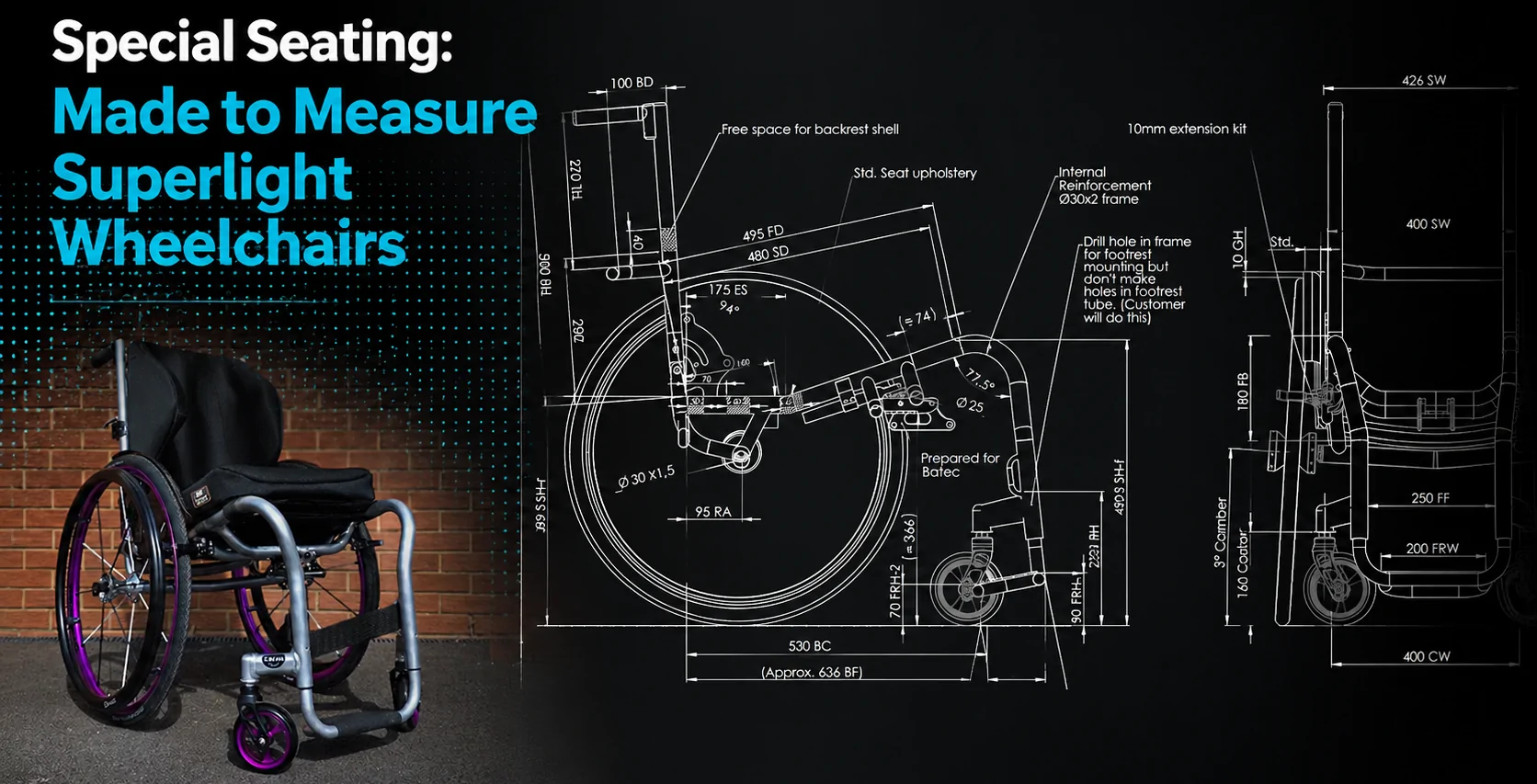
Once confirmed, we proceeded to measure the final wheelchair – a Wolturnus Tukan SL, an ultra-light, fully welded rigid frame at approximately weighing approximately 4kg.
Key design considerations included:
1. Allowing for backrest depth and mounting hardware within frame length
2. Adjusting centre of gravity for additional seating mass
3. Optimising seat depth and Ergo seat integration around IT position
4. Maintaining clearance for side guards and seating interfaces
The frame was specified slightly longer than a standard equivalent to prevent anterior displacement caused by the seating system.

Final Stage
Build, Delivery and Final Handover
The final chair was built with a brushed aluminium frame, Spinergy LX wheels, and purple anodised detailing.
Because the seating and geometry had already been confirmed during mid-fit, final setup focused on minor adjustments, including backrest refinement and footplate positioning.
The completed system provided:
1. Improved postural symmetry and trunk support
2. More appropriate pelvic and femoral loading
3. Improved propulsion efficiency
4. Reduced overall weight compared to previous setup
Summary
This case demonstrates that custom seating can be successfully integrated into superlight, made-to-measure wheelchairs when the process is structured correctly and considered throughout every stage of the assessment and build.
Rather than treating seating and frame as separate components, the key is to assess them as a single biomechanical system.
With staged fitting, mid-validation, and careful geometry planning, it is possible to achieve both clinical postural support and high-performance active wheelchair function in the same setup.