



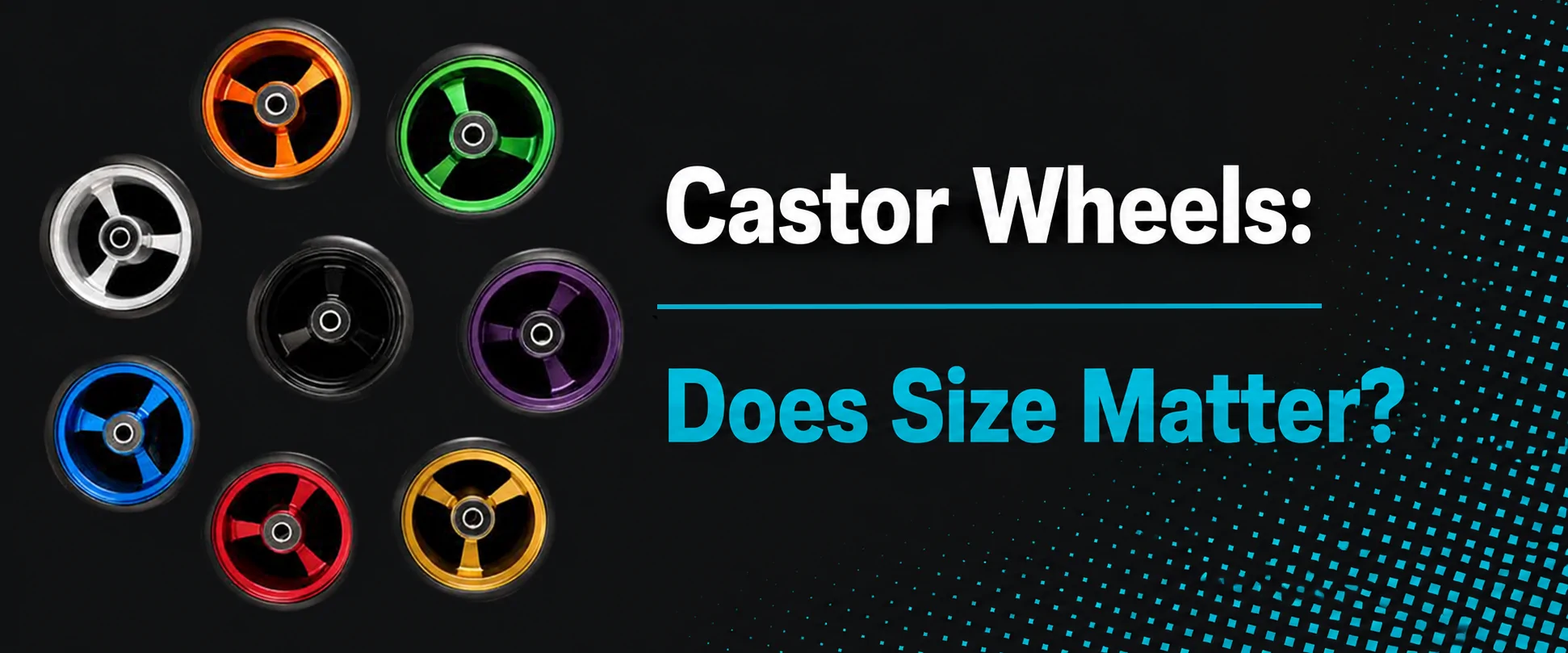
Read on to find out how choosing the right castor wheel size affects not only your chair, but everyday usability and comfort.
Wheelchair Castors Explained: How Size Shapes Your Ride
When it comes to manual wheelchairs, people often focus on the rear wheels – but castor wheels (the small front wheels) play just as crucial a role.
They’re responsible for steering, stability, and how your wheelchair interacts with the surfaces you wheel over every day – Whether you’re navigating tight indoor hallways, cracked pavement, or grassy parks, castor size isn’t just about aesthetics, it’s about real world performance, comfort and efficiency.

Common Castor Wheel Sizes
Castor wheels come in a range of diameters, with sizes from 3″ (76mm) up to 6″ (150mm) being the most common. Some chairs even offer larger castors, up to 8″ or more!
The diameter (the height of the castor) has the biggest impact on how your chair performs.
With small, faster turning castors suiting sports chairs that only roll on nice flat surfaces to larger castors, such as those found on beach chairs, making challenging terrain easier to navigate.
Small but mighty
Castor wheels might be small, but choosing the right size can transform how your wheelchair feels and performs in relation to:
Larger castors roll over bumps, cracks, and uneven surfaces more efficiently – think of how a big tyre on a bike or wheelchair makes short work of rough terrain, they roll easier over irregularities.
Research supports what many users experience in daily life: Larger castors tend to reduce rolling resistance on both indoor and outdoor surfaces. In tests comparing 4″, 5″, and 6″ sizes, the 4″ wheels showed highest resistance, while 5″ and 6″ wheels rolled more efficiently. So if your route includes outdoor terrain, uneven pavements, or bumps – larger castors can make your chair significantly easier to push.
Smaller castors are lighter and have a smaller turning arc, meaning the chair feels more nimble and easy to manoeuvre in tight spaces – great for indoor use, small apartments, busy corridors, or crowded shops.
It’s a trade-off: More agility versus better obstacle clearance. This why you tend to see smaller castors on dedicated sports wheelchairs, they need the fastest turning advantages and dont tend to be used on anything other than smooth surfaces.
Two examples of modern wheelchair castors....

Bowhead 7's
The Latest Tech
Bowheads new hubless design castors.
Improved Durability and enhanced radial load capability.
Reduced wear and tear with better resistance to contamination.

Omobic Castors
The Staple
Omobic offer castors in both Alucore and Fibrecore.
The ideal balance between lightweight design and premium quality.
Added benefit of colour options to complement your wheelchair.
Conclusion
Choosing the right wheelchair castors comes down to how and where you use your wheelchair. If you mainly use it indoors, or on smooth-ish surfaces, mid-size castors are usually the better choice, as they make it easier to manoeuvre through tight spaces and around furniture whilst still allowing some roll over ease. Alternatively if your route includes outdoor terrain, uneven pavements, or bumps – larger castors can make your chair significantly easier to push compared to small castors benefitting specific sports chairs.
Ultimately, the right castor size can make a noticeable difference to your comfort, control, and overall mobility. By choosing a setup that suits your lifestyle, you’ll enjoy a smoother, more responsive ride. Whether you’re upgrading your current wheelchair or replacing worn-out parts, get in touch to discuss our wide range of type, colours and various sized castors.
Have a browse through our castors below..
..or give us a call to discuss what would suit you best.


